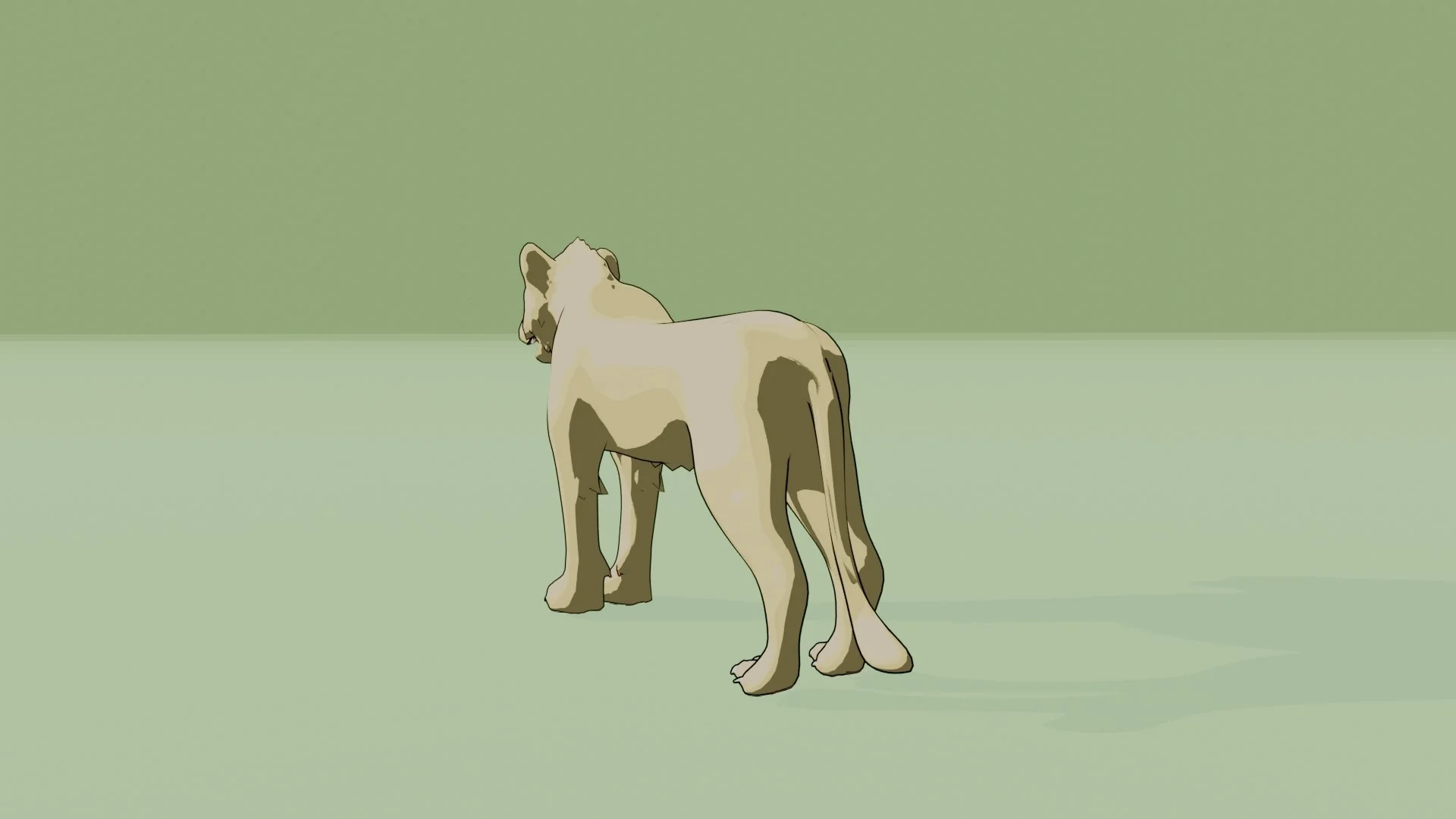
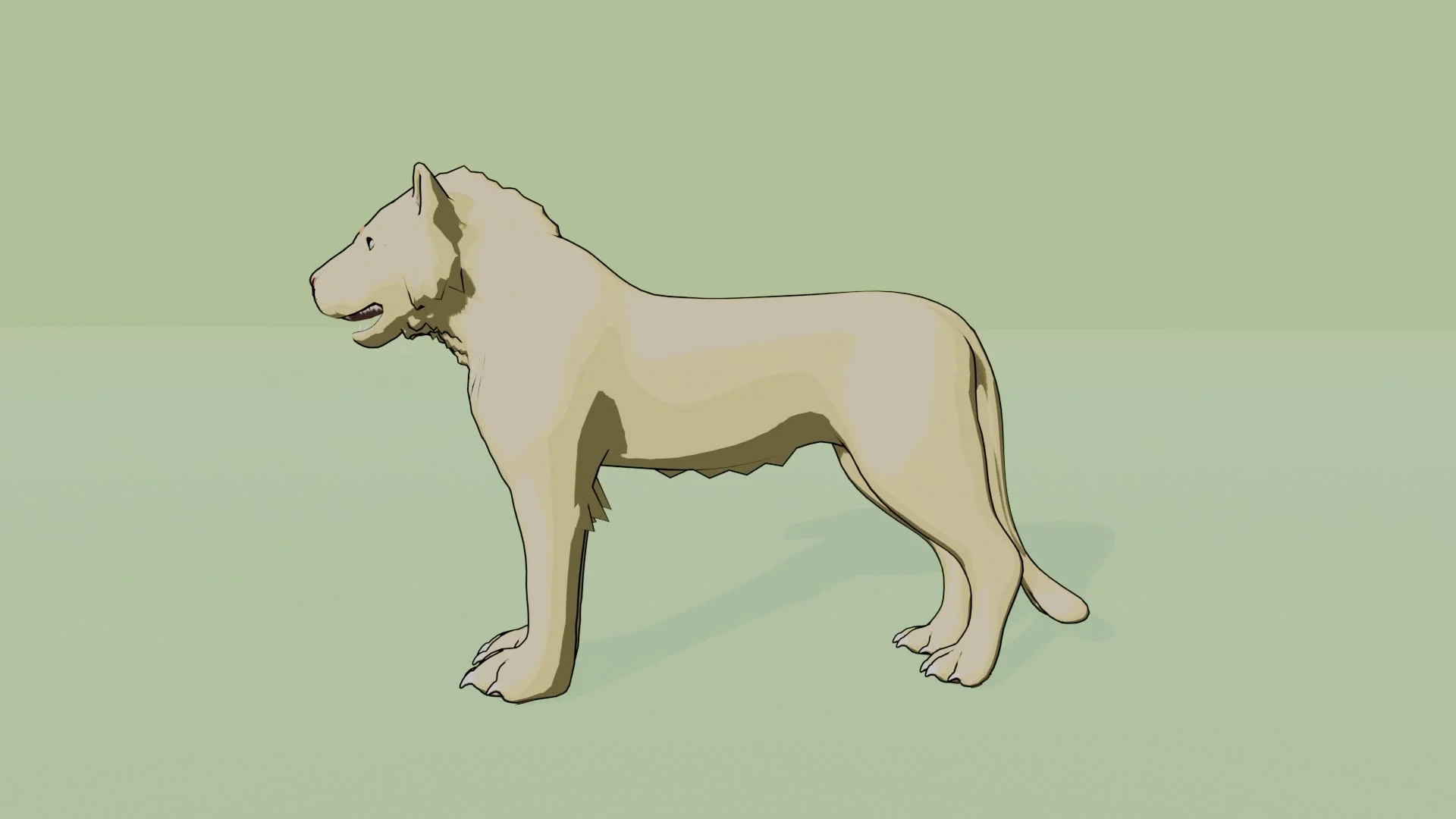
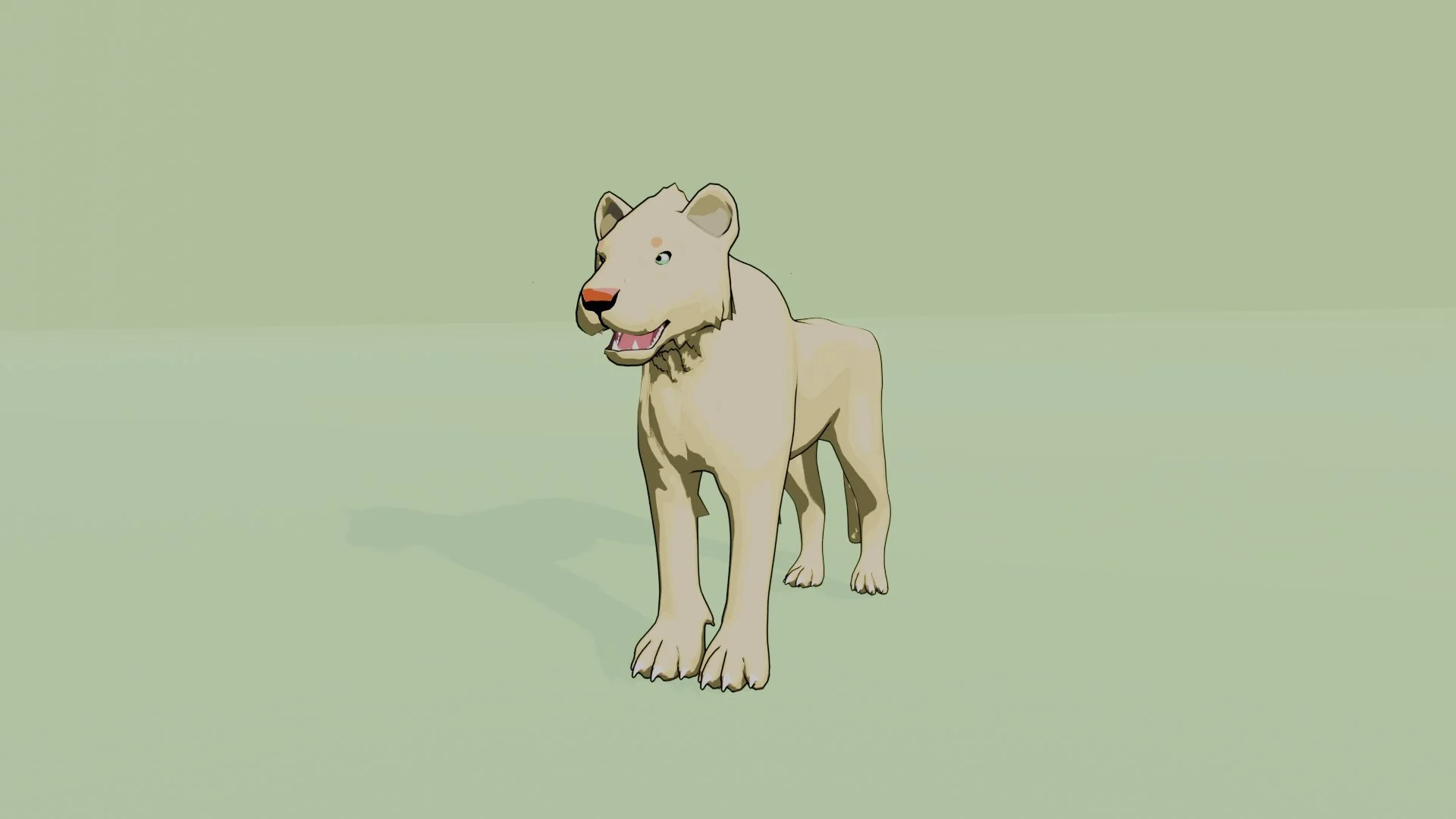
A 3D turntable render of Aibu’s character model, created in Blender
The Design Brief
For the final project in IMS 215, I completed an open 3D modeling project, whose brief was left entirely to my discretion. With this project entirely up to me, I decided to undergo the ultimate task: I would model and texture a fully realized, toon-stylized character entirely from scratch.
The Concept + Research
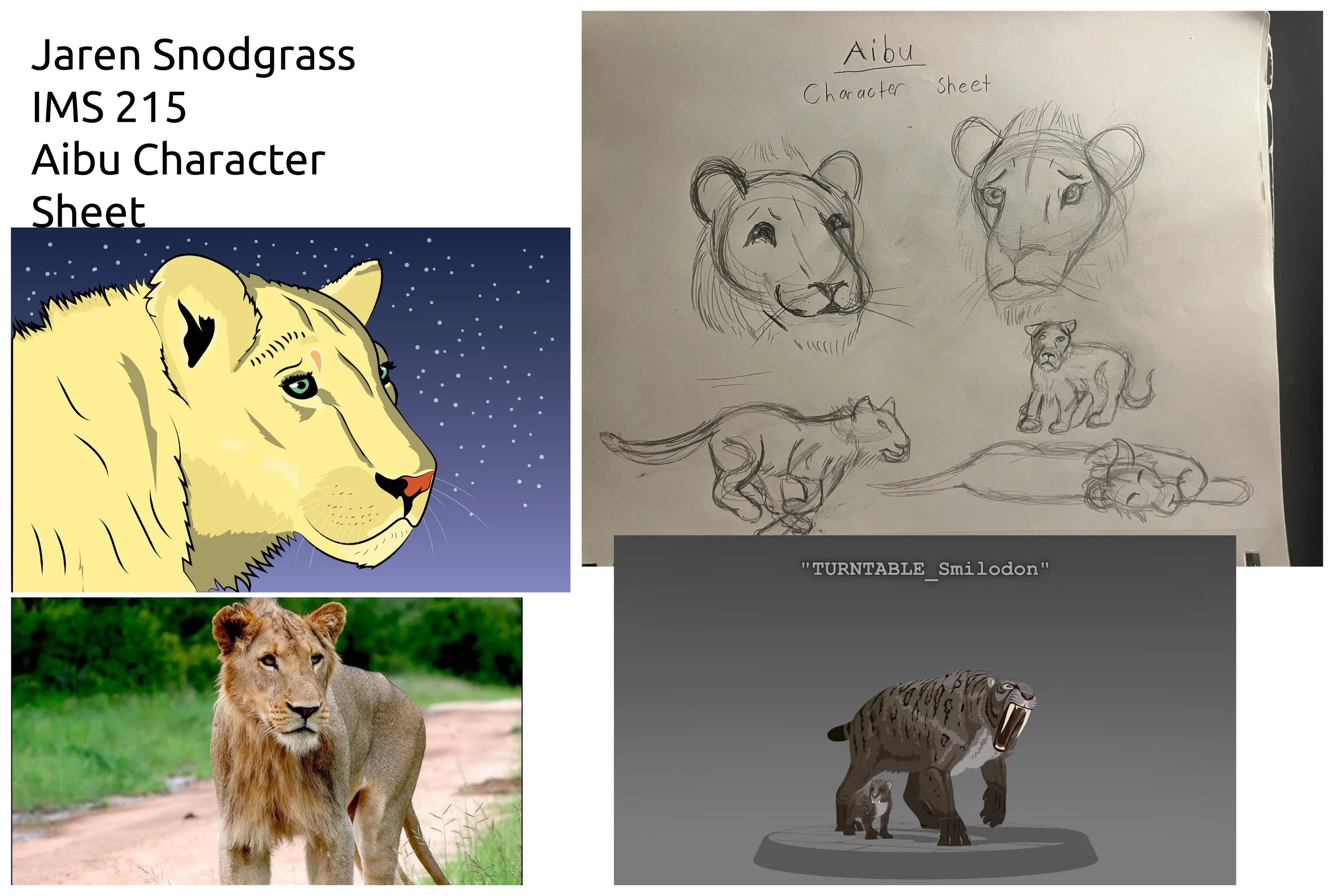
I decided that I would model a character from the novel I was writing at the time, Blood Acacia. I would be modeling Aibu, a young male lion and the protagonist of the story. This was a character I had previously represented artistically for my Blood Acacia TCG project. The challenge would come in taking this 2D illustration, and turning it into a 3D model. The intention would be to eventually rig and animate this character for future projects, and so I had to make sure that my model was well-constructed with good topology.
Early on, I knew that I didn’t want my model to be “hyper-realistic”, as I felt that would take away from my model feeling like a true character. Instead, I wanted to experiment with cel-shading in order to give Aibu a more stylized appearance. Using cel-shading tactics to give 3D models a more 2D appearance has become especially popular in recent animated projects such as the Spiderverse films, Kpop Demon Hunters, and The Bad Guys, and so it seemed like a style worth attempting.
When gathering reference, I obviously used my own drawing of the character as primary reference, as well as photographs of real adolescent male lions for the purposes of anatomical accuracy. I also gathered reference from other artists, primarily David Armsby, or Dead Sound on Youtube. This creator has created a suite of 3D animated short films, and most interestingly, they are all stylized in such a way that they can blend in with 2D elements. I found his style to be incredibly alluring, and so he became a primary inspiration for how I would approach my model’s appearance.
The Process
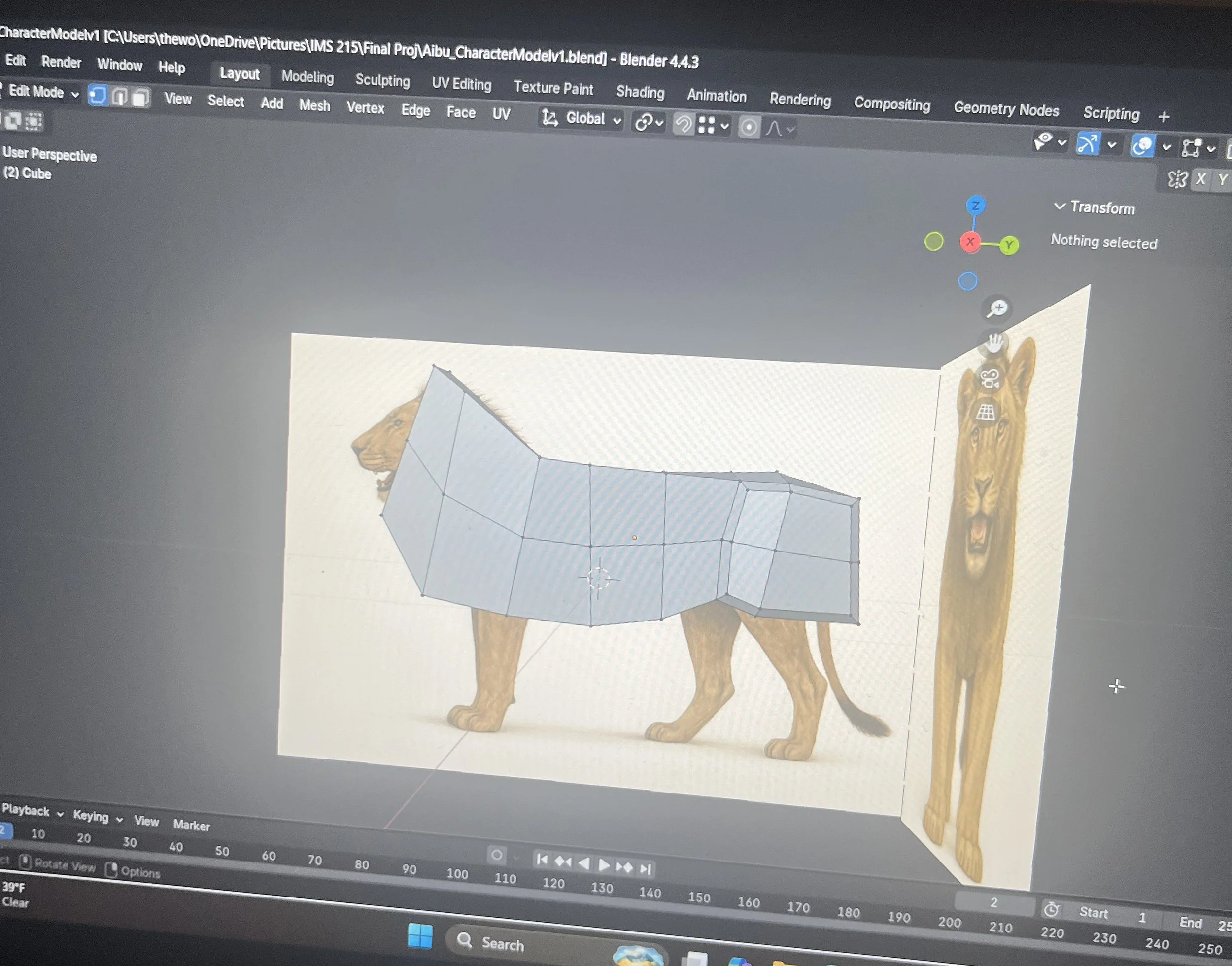
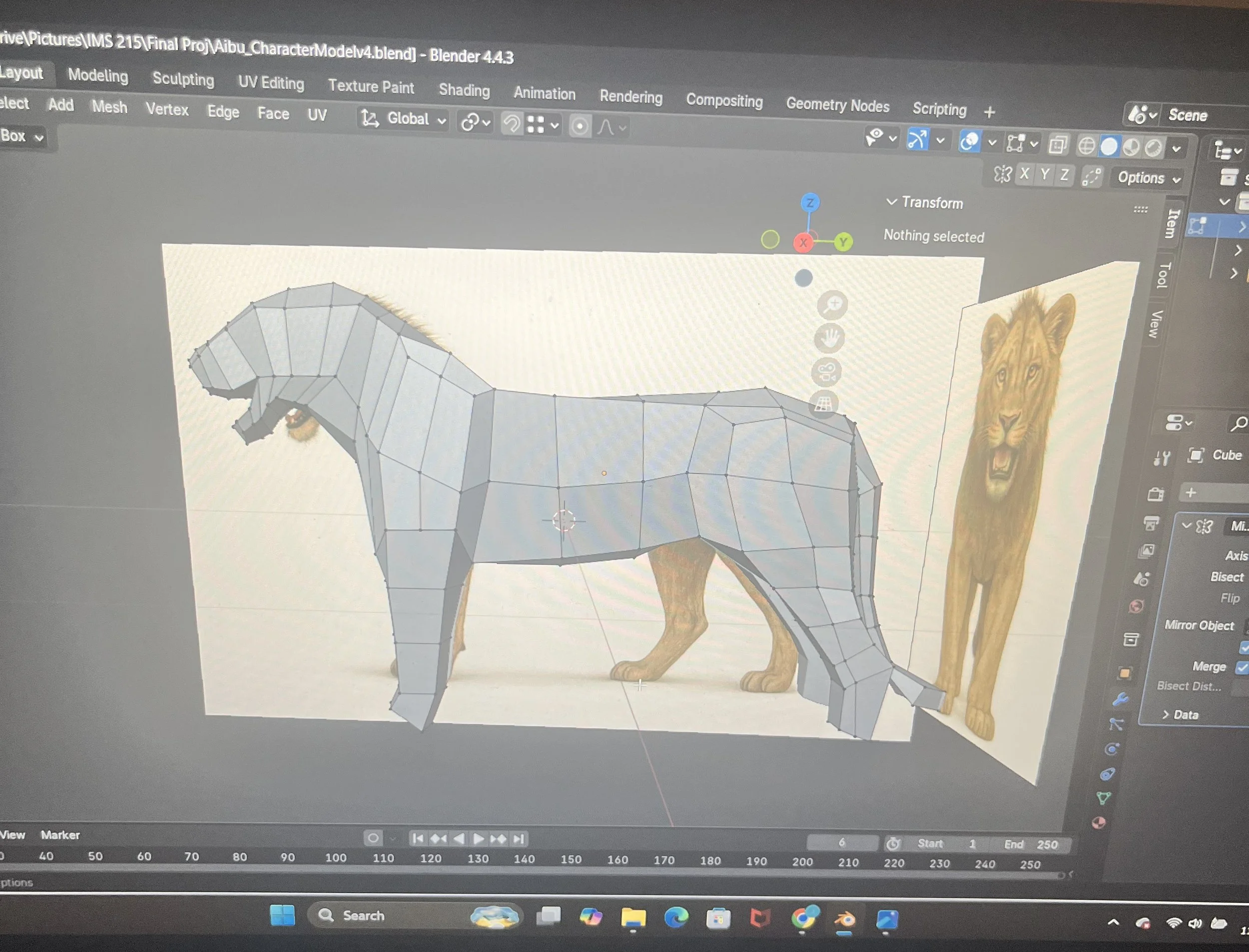
Using the program Blender, I began my modeling process with a humble cube. Utilizing both a front and side view of a young lion for anatomical reference, I then subdivided and extruded parts of this cube in order to rough out the essential shapes of the character. This process can best be described as “technological playdough”, essentially pulling out different parts of a basic shape in order to turn it into something more complicated. Utilizing reference was key in order to make sure that my model was proportional, as even if the character is stylized, he still had to visually communicate that he is a lion. However, some slight deviations were made, such as making the model thinner and more gangly in some places. In my novel, Aibu is thin, pale, and underdeveloped for his age. I wanted the model to not just show that he’s a lion, but also show that he is young and still growing. Capturing Aibu’s adolescence was just as important as capturing his species.
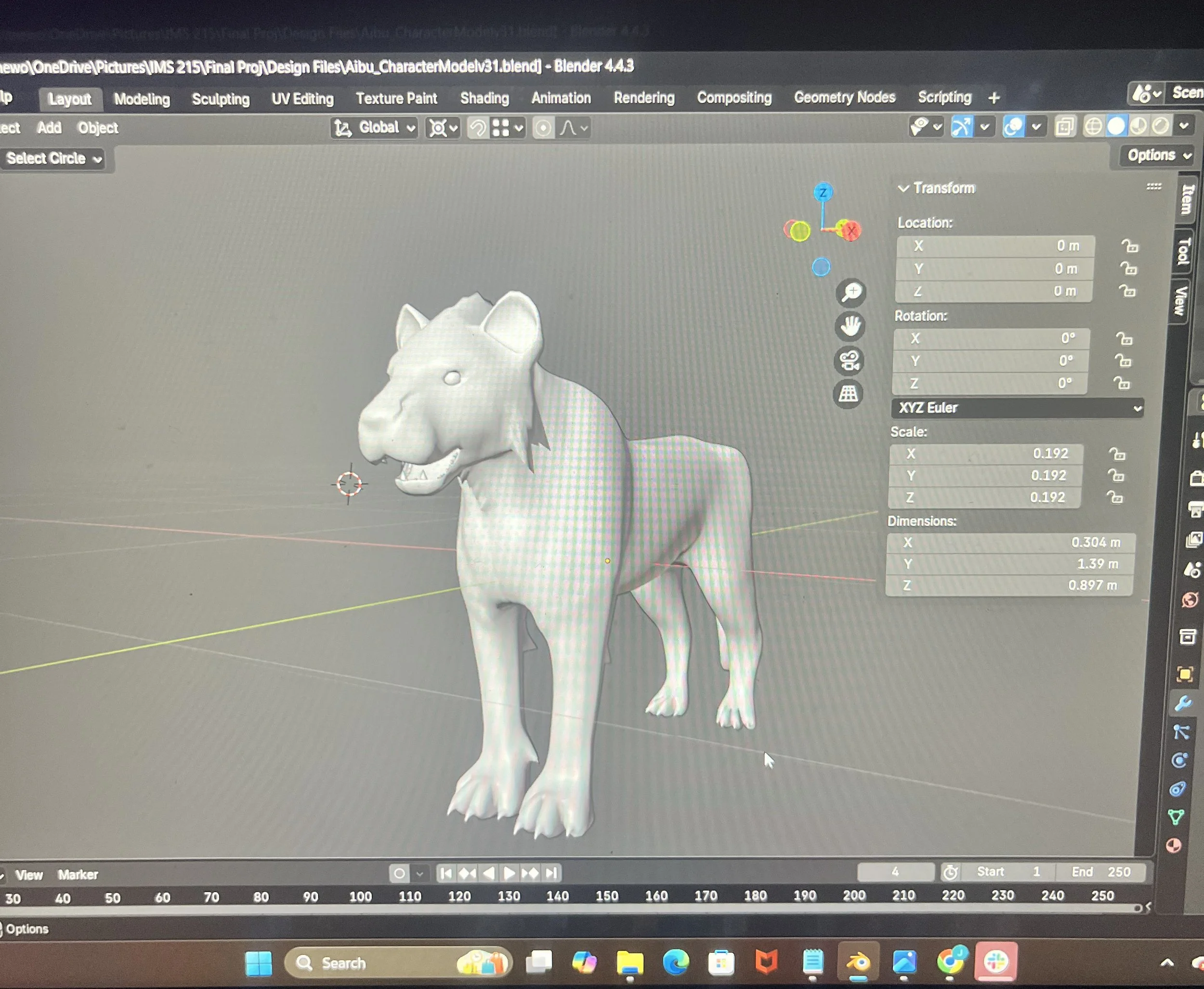
The initial model that I created most definitely left some to be desired, with the head especially not quite capturing the leonine visage that I was looking for. After departing with $20 on TurboSquid, I managed to find a decent 3D model of a lion to use as reference, and better proportion my character in order to capture the look I needed. Once the body mesh was completed, I then went on to model the eyes and teeth, both of which were separate meshes. This would make rigging the model much more manageable in the future.
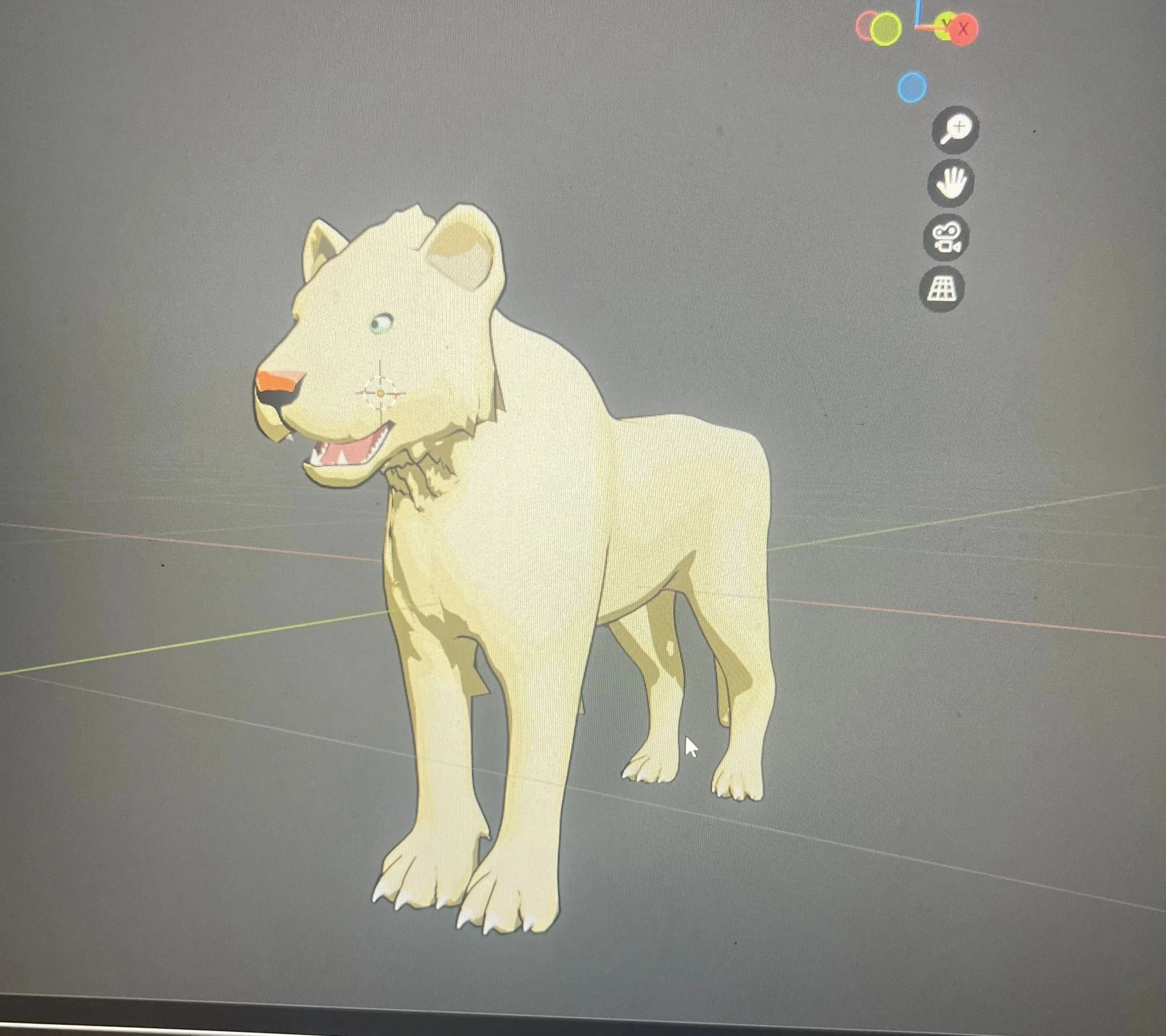
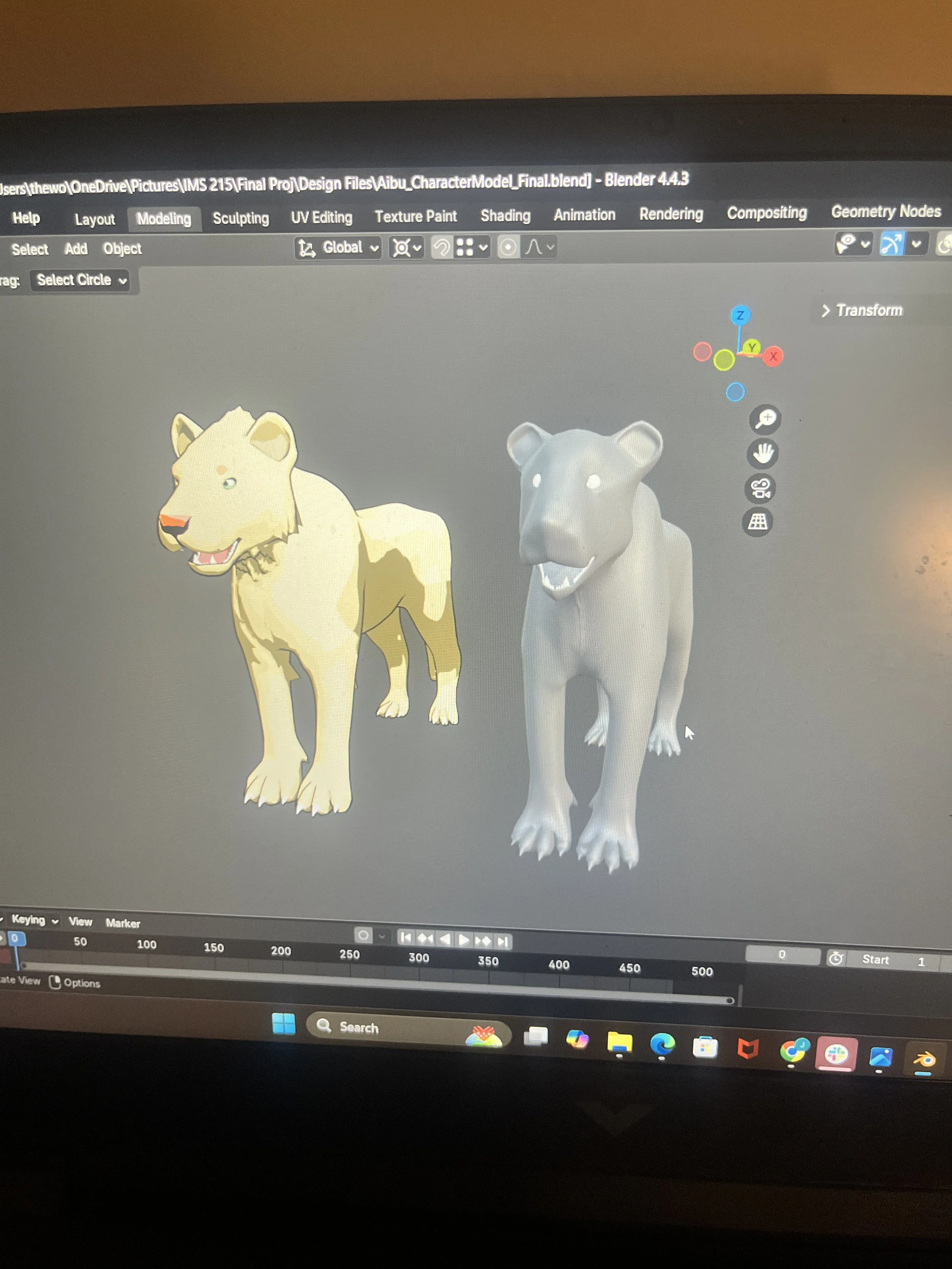
Once Aibu’s model was completed, there came the task of coloring him, which would add the vivacity that the model needed. By utilizing a cel-shade material within Blender, I actually managed to forego the need for any traditional texturing on Aibu’s model. Instead, his entire body utilizes a cel-shaded material, made up of a selection of colors. This means that Aibu’s model dynamically changes colors depending on light conditions, and makes him much more usable in different 3D scenes. I used my original 2D depiction as color reference, giving Aibu a tan cream coat with striking green eyes. I also utilized modifiers in order to give Aibu’s model a black outline, furthering the illusion of a 2D drawing in 3D space and giving him the “toon” look that I wanted. However, there was the matter of some of Aibu’s finer color details, namely the black streaks around his nose as well as his peach-toned “eyebrows”.
Instead of utilizing textures, I instead decided to use Blender’s grease pencil tool, which allowed me to directly draw on top of his character model. Interestingly, Blender is able to take these drawn lines and treat them as a separate mesh, which simply lay on top of Aibu’s model. I found this to actually supplement his overall “toon look” in a clean and satisfying way, and the end result ended up being something I was extremely pleased with.
The Reflection
I am extremely pleased with the final result of this project, and even more pleased with myself for following through on such a task. Prior to this project, I had never attempted to model a living creature entirely from scratch. Unlike in my Cave Lion sculpt, I did not have the model of another animal to work from: Aibu’s model had to be created entirely from scratch. In spite of this, however, I believe that I’ve managed to not only capture the visage of a lion but, more importantly, Aibu’s character.
Just looking at the model, I feel that one can clearly tell that this animal is young. With lanky proportions, an almost awkward gait, a small mane, and large eyes, Aibu visually presents as adolescent and not quite fitting into his body, which is a core part of his character in the story. I wanted this project to be more than just modeling a lion, I wanted to ensure that I was modeling Aibu specifically, and I believe that I managed to accomplish just that.
Going forward, the intention is to rig this model in order to get him into a state that can be animated. I have a very exciting future project that I intend to utilize Aibu’s model for, and so having him in a state that he can be animated in will be crucial. However, as he is now, I feel that this model is a satisfying first attempt at character modeling, and I am overjoyed at what I managed to accomplish in such a relatively short period of time.