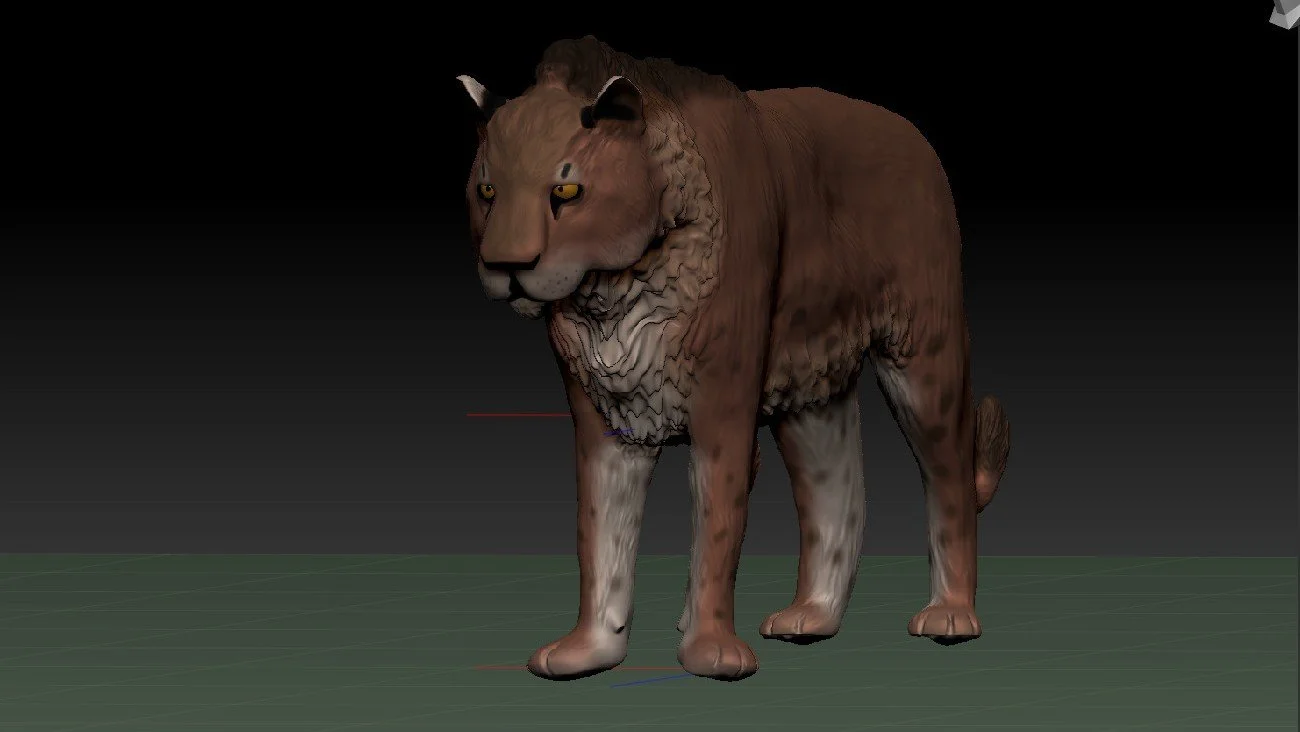
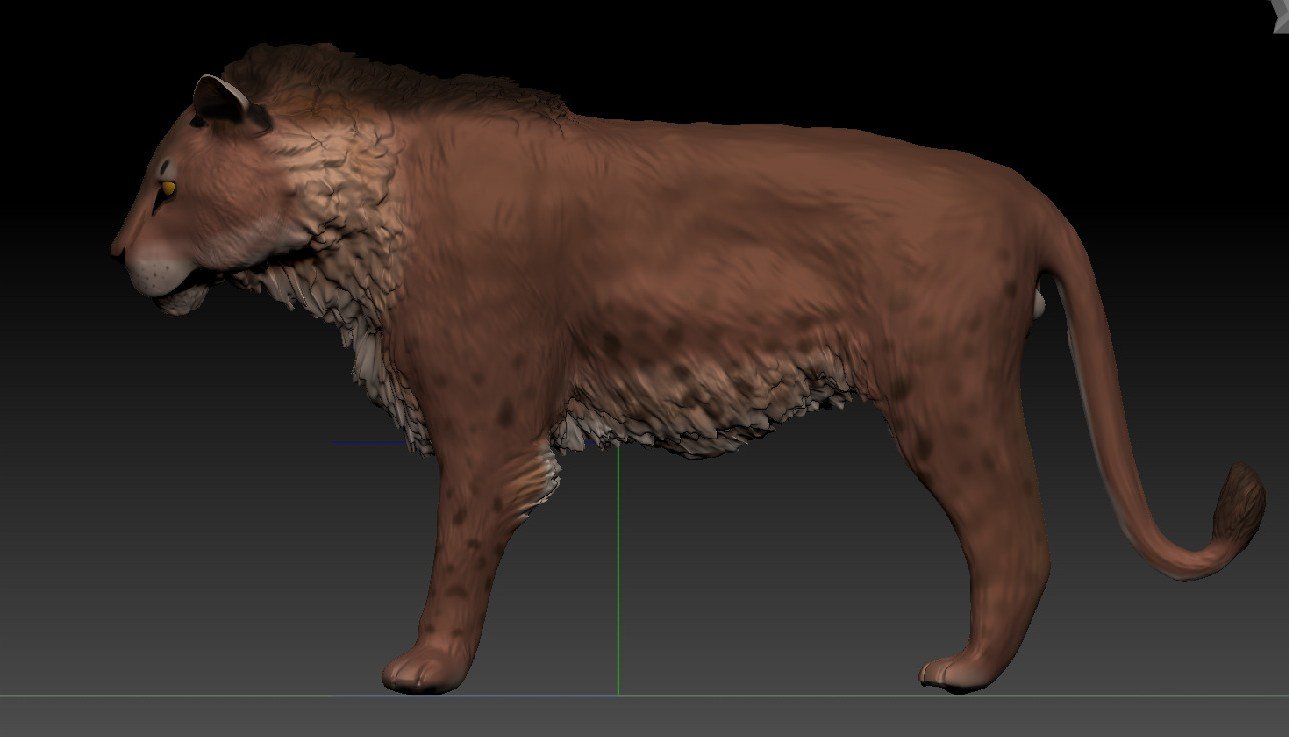
A 3D turntable of my cave lion render, created in Zbrush.
The Design Brief
In IMS 215, I was challenged to sculpt an extinct animal as the second project of the course. The criteria for our subject was clear: the animal we chose had to be extinct, and there could be no photographic record of the animal either. The challenge of this brief would be in sculpting and interpreting an animal purely based on its fossils, living relatives, and artistic depictions based entirely on speculation.
The Research
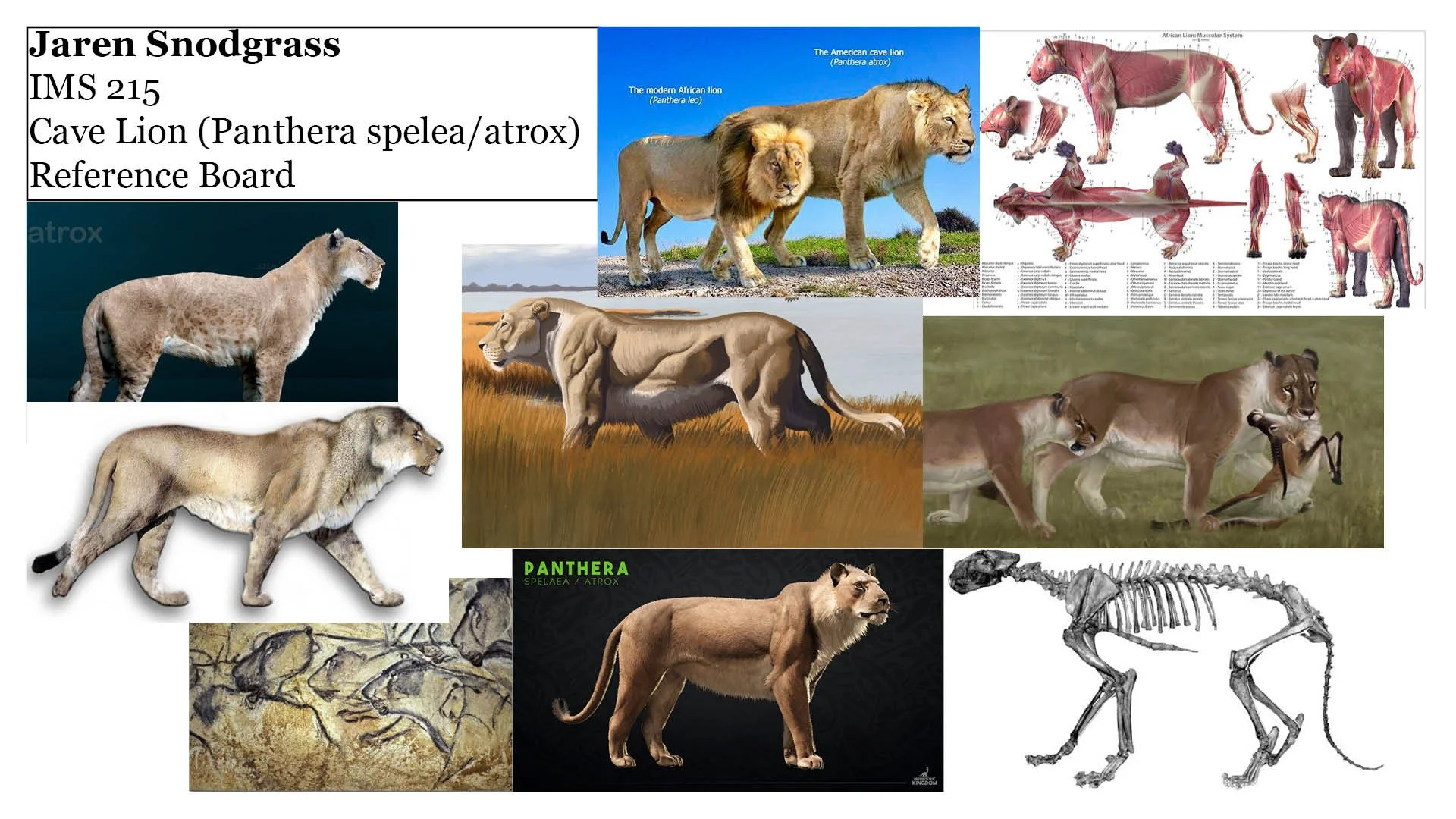
The extinct animal I selected to sculpt was the Cave Lion, an extinct big cat that lived across North America and Eurasia during the last ice age. I chose this animal because while it was extinct, it also had multiple anatomical similarities to living big cats, meaning that there would be a good foundation of living reference to add to my model’s overall verisimilitude. By extension, another project that I was planning for would require the modeling and animation of an animal character, and so this project would serve as a basis in order to build the skills necessary for that task.
I began researching and assembling reference for my model. This included compiling artistic depictions of cave lions, fossil images, and anatomical references from modern lions. What I found most interesting in my research was the different cave paintings that were drawn by ancient peoples who saw living cave lions. In a sense, these paintings are a more faithful interpretation of this animal than any drawing or model created by contemporary artists, which I found to be incredibly poetic.
The Process
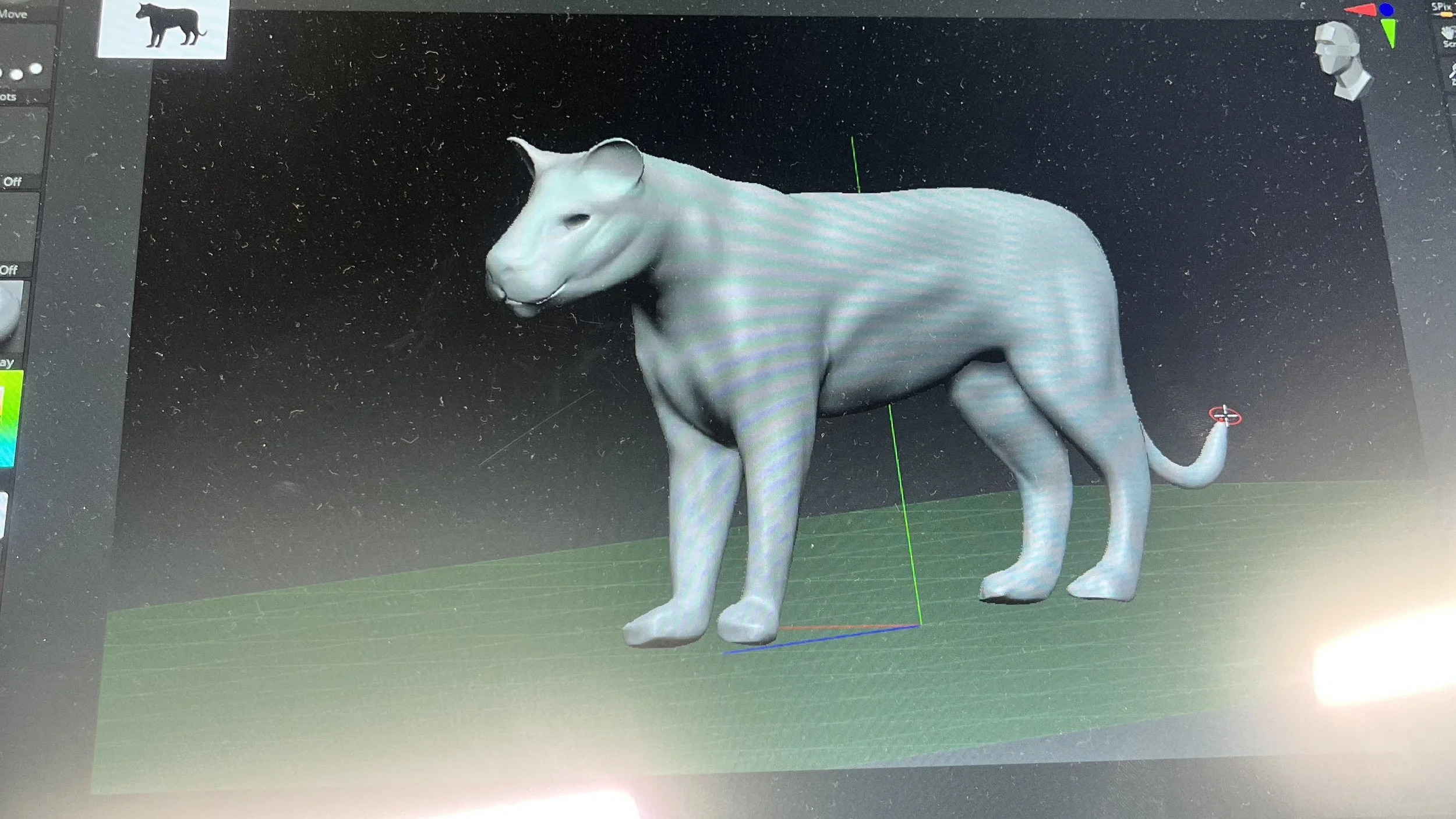
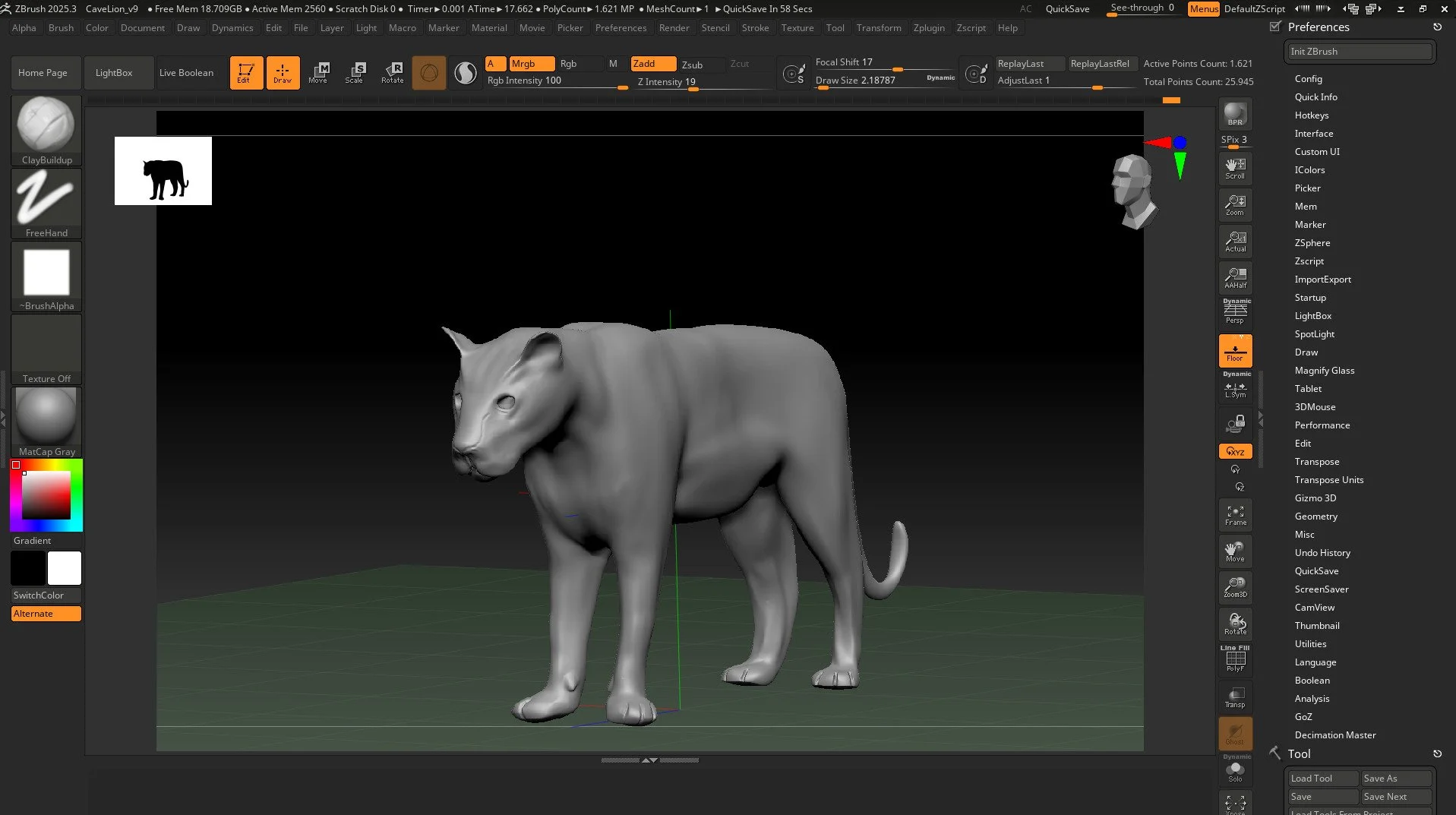
For this project, my professor provided the class with an assortment of animal models in FBX format to use as a starting point for our extinct species. These models included a cow, lizard, horse, and cat. Naturally, I used the cat as a base, and began modifying the mesh and sculpting it out using ZBrush. Bar none, the greatest challenge of this process was making the proportional adjustments needed for my sculpt. Lions aren’t just bigger house cats, but the way in which their bodies are proportioned is completely distinct. Big cats had broader heads, longer spines, larger and bulkier paws, and overall much more muscularity than house cats. For cave lions in particular, they are more robust and heavily built than African lions, meaning my model would have to reflect a degree of muscularity and heft that was beyond what my anatomical references showed.
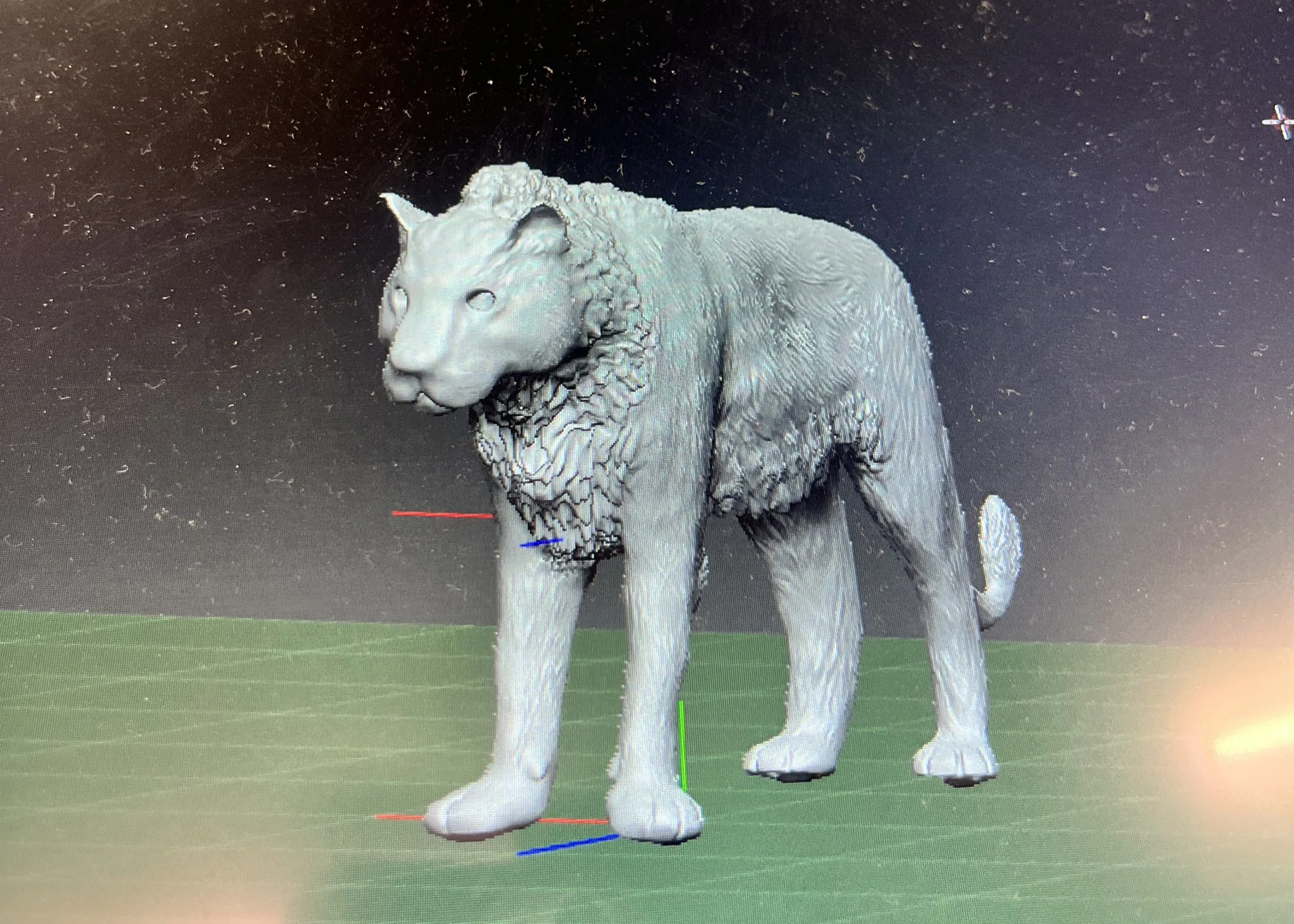
Once the base anatomy was sculpted, there came the addition of fur onto the model. I utilized a free fur brush online to create not just the contour fur on the body, but also the larger clumps of fur that formed around the head and underside of the body. Unlike modern lions, cave lions did not have large manes, and so my model instead has more of a scruff around the face and neck. It was also important for the fur to appear much thicker and more dense than it does on modern lions, since cave lions lived in polar environments alongside mammoths and other ice age megafauna.
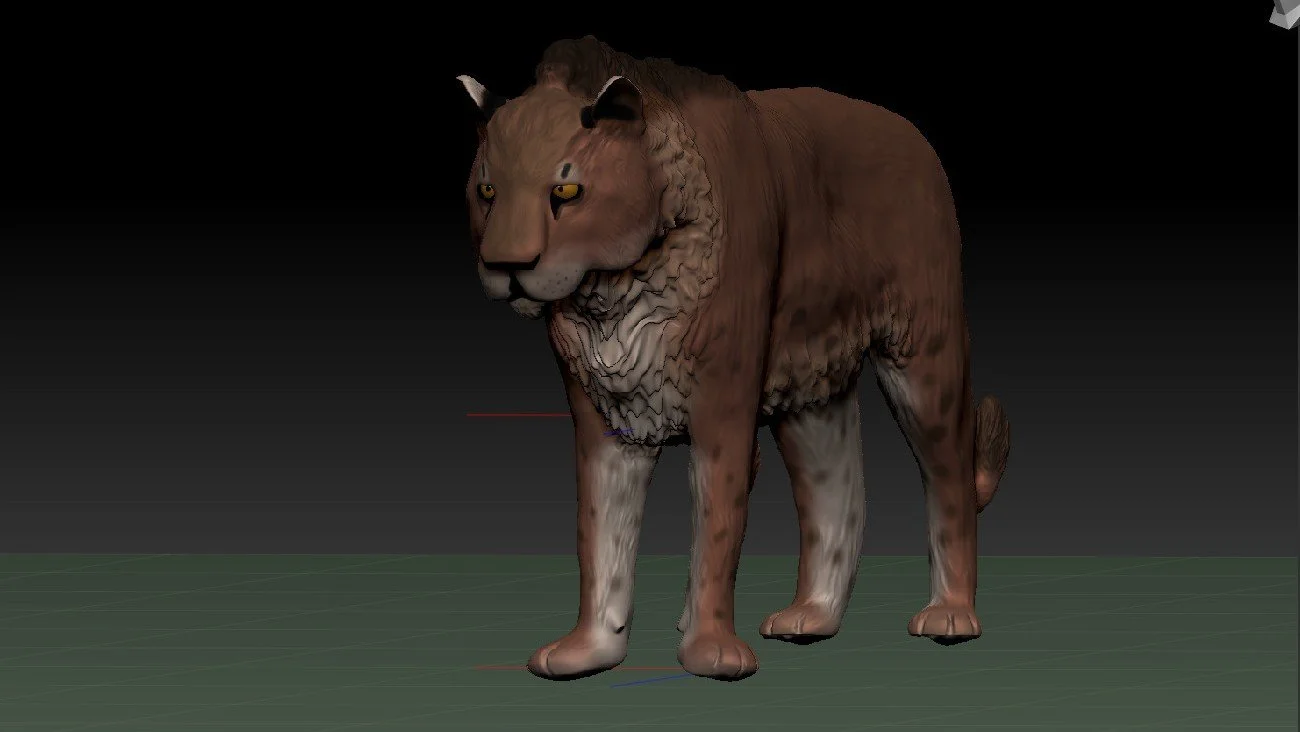
After sculpting the model, it was time to color it. All textures were hand-painted within ZBrush, and I utilized a wide array of reference for how I textured my cave lion. Modern lions are most well known for their blonde, golden fur, but I wanted my cave lion to be distinct. After all, this is an extinct species living in a completely unique environment. I decided to use reddish browns as my primary color palette, as I feel those colors best communicated a cold-weather animal (think bears, bison, or mammoths). By extension, I also included faint rosettes, or spots, along the underside of my lion. When they’re cubs, African lions are actually covered in these same rosettes, which begin to fade with maturity. However, on some lions, these rosettes can remain even once they become adults, and so I wanted to depict my cave lion with some of these rosettes still present, implying that he may be a bit younger for some additional storytelling.
One of the most interesting details added was the “tear marks” that go from the cave lion’s eyes toward its muzzle. These marks are consistently portrayed in different cave paintings of cave lions by ancient peoples, and so it appears that this was a trait that the living animal possessed. Therefore, it was important to me that this detail was included in my model.
The Reflection
This project was a great exercise in modeling an organism. Unlike creating a tool or a rock, sculpting a living creature required a new degree of finesse and specificity that other 3D projects hadn’t yet required of me. I wanted my cave lion to look and feel like a real animal, like it could start walking off of the screen, and I believe that I achieved this very well.
This project required an understanding of not just 3D software and sculpting fundamentals, but animal anatomy and physiology as well. My cave lion successfully encapsulates both principles.
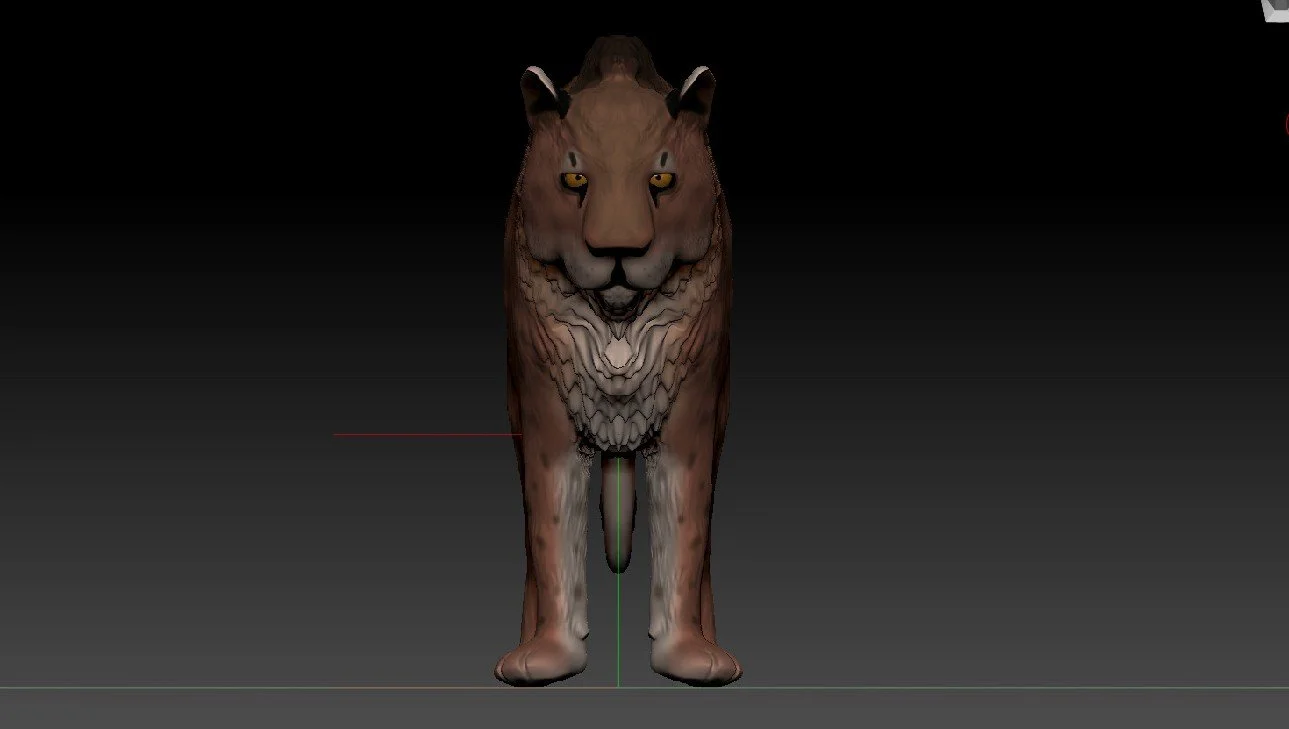
Now, that is not to say that I believe my model is perfect. On the contrary, I feel that some aspects of this model, namely the face and paws, could use some proportional adjustments in order to bring the model more in-line with big cat anatomy. However, for my first attempt at modeling a live animal, I believe that I met the design brief successfully, and am able to look back on this model with pride.